
The recent Arsenal Ezri Konsa transfer has left many pundits and supporters momentarily perplexed. Despite boasting the most formidable defensive unit in the Premier League last season, conceding a mere 27 goals, Mikel Arteta has sanctioned a £51 million move for the Aston Villa stalwart. This comprehensive analysis explores the underlying tactical necessities, injury concerns, and overarching ambitions that justify this seemingly superfluous acquisition.
The Defensive Paradox at the Emirates Stadium
If there was one area on the pitch where Arsenal appeared entirely impenetrable during the previous campaign, it was the heart of their defence. The North London club effectively constructed a fortress, registering a staggering sequence of four consecutive clean sheets across April and May. This immense defensive solidity was the cornerstone of their successful title defence, ensuring they remained resolute even under immense opposition pressure.
BGD88 Analyzes: Why Fix What Is Not Broken?
At first glance, the Arsenal squad is utterly replete with elite defensive talent. In William Saliba and Gabriel Magalhaes, Arteta possesses arguably the most formidable centre-back partnership in global football. Furthermore, the roster is bolstered by highly versatile, premium rotational options. Riccardo Calafiori, Ben White, Jurrien Timber, and the recently acquired Piero Hincapie provide exceptional depth.
These players are tactically fluid, capable of operating centrally or deployed as inverted full-backs. Additionally, the club’s prestigious Hale End academy continues to produce gems, with 16-year-old prodigy Marli Salmon already on the fringes of the first team. Therefore, committing £51 million—plus an additional £4 million in performance-related add-ons—for another centre-half demands profound scrutiny. For followers seeking the latest Premier League updates BD, this move signals a fascinating shift in Arsenal’s squad-building philosophy.
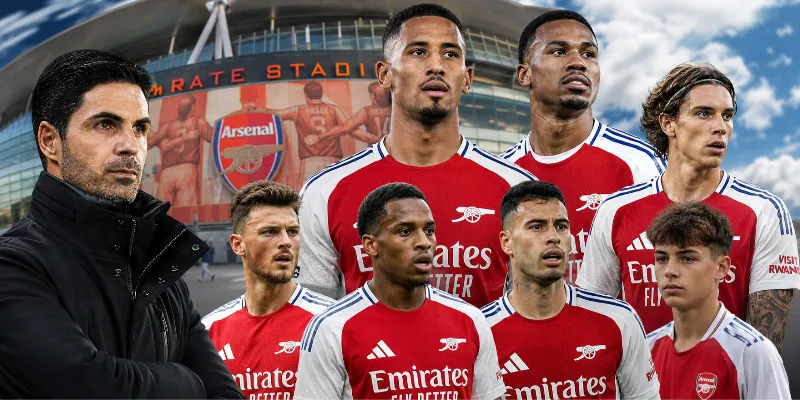
Behind the £51m Arsenal Ezri Konsa Transfer
To truly comprehend this monumental transfer, one must look beyond the surface-level statistics of last season and delve into the harsh physical realities of the current Arsenal squad. The truth is, while the defensive record was impeccable, the personnel responsible for it are currently navigating a treacherous period of physical fragility.
The Injury Crisis: Saliba and Timber
A significant portion of the defensive bedrock that secured Arsenal’s triumph will be unavailable for the gruelling opening weeks of the new campaign. William Saliba, the elegant French international, has been ruled out for a prolonged period due to a persistent lower back issue. This is a chronic condition he bravely managed throughout the previous season, one that tragically curtailed his World Cup journey with the French national team.
Similarly, Jurrien Timber, arguably Arteta’s preferred first-choice right-back when fully fit, is sidelined with a complex groin strain. This recurring muscular issue has plagued the Dutchman, previously forcing him to withdraw from the Netherlands’ World Cup squad.
Arteta’s Tactical Rigidity Regarding Left-Footed Centre-Backs
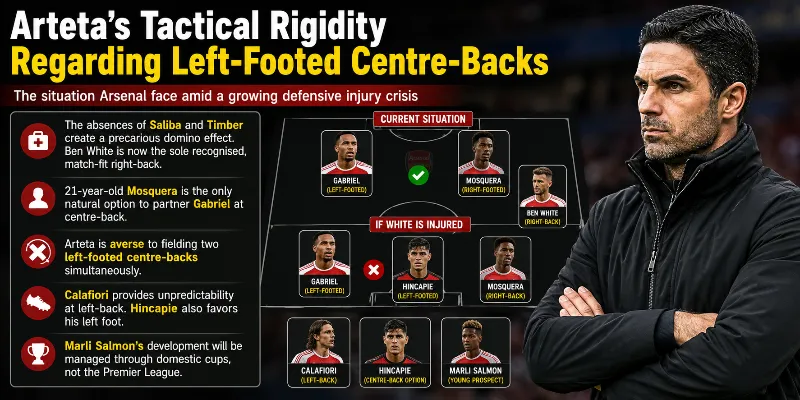
The absences of Saliba and Timber create a precarious domino effect. Ben White, who has valiantly played through the pain barrier with various fitness issues in recent years, is suddenly the sole recognised, match-fit right-back. Meanwhile, the 21-year-old Mosquera emerges as the only natural right-sided option to partner Gabriel at the heart of the defence.
While some might argue that Arsenal could navigate this storm by utilising their recent permanent signing, Piero Hincapie, doing so contradicts a core tenet of Arteta’s tactical manifesto. The Spanish manager is notoriously averse to fielding two left-footed centre-backs simultaneously. If White were to succumb to injury, forcing Mosquera to shift to right-back, Arsenal would be forced into this unbalanced left-footed pairing.
Arteta specifically utilises Calafiori as a left-back to inject unpredictability into Arsenal’s offensive transitions, whilst Hincapie also heavily favours his left foot. As for the promising Marli Salmon, his development will be carefully managed through domestic cup fixtures rather than the unforgiving environment of the Premier League.
What Ezri Konsa Brings to North London
Before finalising the Arsenal Ezri Konsa transfer, the club’s recruitment department had cast a wide net, heavily scouting Bayer Leverkusen’s Jarell Quansah due to his ability to operate as both a right-back and a right-sided centre-half. However, the decision to pivot to Konsa aligns perfectly with the club’s desire for immediate, battle-tested quality.
At 28 years of age, Konsa is entering the absolute prime of his athletic and professional career. He arrives not as a prospect, but as a seasoned international and a European champion, having been instrumental in Aston Villa’s triumphant Europa League campaign.
Elite Ground Duels and Passing Accuracy
For analysts and fans keeping track of Arsenal news Bangladesh, Konsa’s underlying metrics are nothing short of phenomenal. When analysing defenders who engaged in 20 or more ground duels last season, Konsa reigned supreme across the entire Premier League.
He boasts an astonishing 73.1% success rate in ground duels, outperforming heavyweights such as Nathan Ake (72.7%), Ayden Heaven (71.2%), Virgil Van Dijk (70%), and even his new teammate Gabriel Magalhaes (69.9%).
Furthermore, Konsa is a maestro in possession. He recorded a 95% passing accuracy last season, the highest not just among defenders, but across all outfield players in the English top flight. In Arteta’s possession-heavy, high-pressing system, this immaculate distribution is paramount.
Perhaps most impressively, across 231 Premier League appearances, Konsa has been dribbled past a mere 37 times—averaging an elite 0.17 times per 90 minutes. He is a defensive monolith who rarely loses one-on-one physical battles, a trait perfectly suited for Arsenal’s high defensive line.
Navigating a Congested Fixture List
A lingering question among the fanbase is whether Konsa will command a regular starting berth once the medical room clears. On paper, a fully fit theoretical backline of Timber, Saliba, Gabriel, and Calafiori appears impenetrable.
However, modern elite football is a war of attrition. During their championship-winning season, Arsenal navigated a staggering 63 fixtures across all competitions, battling deep into the Champions League, FA Cup, and League Cup. The physical toll was immense, and Arteta is acutely aware that relying on a rigid starting XI is a recipe for catastrophic burnout.
Premier League Updates BD: Entering the Super-Club Elite
Following their narrow shortcomings in the Champions League final, Arteta publicly declared that Arsenal must remain “highly ambitious, exceptionally swift, and incredibly intelligent” in the transfer market to sustain their domestic dominance.
This ambition is reflected in their financial outlay. After investing £250 million last summer, the club has committed nearly £200 million in the current window. According to global valuation metrics, Arsenal now boasts a squad worth an estimated £1.45 billion, giving them a depth of quality rivalled by very few institutions across Europe.
As Arsenal’s Managing Director Richard Garlick unequivocally stated, transitioning into the exclusive echelon of football’s global “super-clubs” is no longer just a dream; it is the definitive, operational ambition of the North London giants. The acquisition of Ezri Konsa is a definitive statement of that exact intent.